
WHAT JUST HAPPENED PODCAST
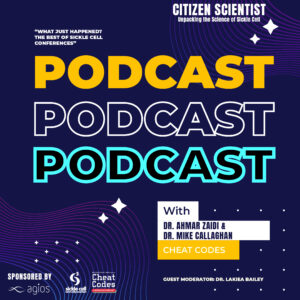
The Sickle Cell Community Consortium (SC3) has partnered with Dr. Ahmar Zaidi and Dr. Michael Callaghan of Cheat Codes to present The Best Of podcast series featuring the most exciting abstracts and presentations in sickle cell science and research at ASH, FSCDR, and EHA. The Sickle Cell Community Consortium (SC3) is a U.S. based 501c3 non-profit created to provide a platform to ensure that the sickle cell patient and caregiver voice is at the center of education, research, advocacy, legislation and policy. SC3 currently hosts two major conferences, attended by over 800 patients and caregivers annually, and is the organizing entity for dozens of patient-led projects, platforms and initiatives, collectively engaging thousands of sickle cell patients and caregivers. This podcast series, along with our efforts to create enduring materials focused on explaining the science behind the Best Of series, is designed to ensure that the sickle cell patient and caregiver is armed with the known.
ABOUT CHEAT CODES
Cheat Codes brings listeners a series of segments and interviews packed with critical education and research information that patients and families need to know, as well as updates and clarifications from the social media “buzz” around sickle cell. Hosted by Ahmar U. Zaidi, MD (Dr. Z) & Michael U Callaghan, MD (Dr. Mike).
LISTEN HERE > https://www.bloodstreammedia.com/cheat-codes
ABOUT AGIOS
At Agios, building bonds and cultivating relationships are at the heart of our ability to create life-changing therapies for people with genetically defined diseases.

WHAT JUST HAPPENED?
WARRIORS CONVENTION 2021
PODCAST
PART 1
SICKLE CELL HOLISTIC HEALTH & NUTRITION; THE POWER OF ADVOCACY: LEGISLATIVE, HEALTH, PATIENT; SICKLE CELL SYMPTOMS & SIDE-EFFECTS
PART 2
TRAIT TRACK & YOUNG ADULT TRACK
GUEST SPEAKERS
SICKLE CELL HOLISTIC HEALTH & NUTRITION
 DR. LAMETRA SCOTT
THE POWER OF ADVOCACY: LEGISLATIVE, HEALTH, PATIENT
 FRANCINE BAKER
SICKLE CELL SYMPTOMS & SIDE-EFFECTS
 DR. SIMONE UWAN
TRAIT TRACK
 DR. TOMIA AUSTIN
YOUNG ADULT TRACK
 MIA ROBINSON
EMBRACE Full Playlist
Hydroxyurea & Sickle Cell Disease
Hydroxyurea for Children
Acute Chest Syndrome & Sickle Cell Disease
Understanding Your Complete Blood Count
Sickle Cell & Travel
EMBRACE Engagement
“Nothing for us, without us”
The EMBRACE Network (Education and Mentoring to Bring Access to Care), is a project that seeks to expand access to quality care, improve care delivery and provide knowledge and support.
Participate in a focus group.
Telemedicine, Travel Letter, Opioid Agreement, etc.
- Focus Group #1 – Travel
This first focus group will occur in-person at the 6th Annual Sickle Cell Patient & Family Educational Symposium. Visit www.sicklecellconvention.org to learn more.
- Focus Group #2 – The Opioid Contract
- Focus Group #3 – Telemedicine
- Focus Group #4 – Project ECHO
EMBRACE Empowerment
Join a State Community Advisory Committee.
COMING SOON.
EMBRACE a medical home
What is a medical home?
The Medical Home (also known as Patient or Family Centered Medical Home) is an approach to providing comprehensive primary care that facilitates partnerships between patients, clinicians, medical staff, and families.
Find a doctor near you
The purpose of these referrals are to help people with sickle cell disease identify a doctor with experience treating sickle cell warriors. The goal is to assure continued outpatient care for warriors so that we do not need to depend on emergency or hospital care.
EMBRACE | ECHO® | NHLBI Guidelines | CONTACT
Sickle cell is a genetic life-long disease characterized by episodes of severe pain, frequent hospitalizations, long-term organ damage and a shortened lifespan. Most physicians with expertise in sickle cell disease practice in academic healthcare centers or large medical centers. That means that there are large gaps in access to care. Lack of knowledge about the long-term effects of sickle cell disease and physician assumptions can lead to suboptimal care and a less desirable quality of life for these patients.
The EMBRACE Network (Education and Mentoring to Bring Access to Care), is a project that seeks to expand access to quality care, improve care delivery, and provide knowledge and support through regular ECHO® clinics, like virtual grand rounds, patient case presentations will be combined with didactic learning and mentoring. We invite you to participate in these sessions to engage with a team of multi-disciplinary specialists around the management of sickle cell disease.
ECHO® (Extension for Community Healthcare Outcomes), is an Internationally recognized tele-mentoring model that connects providers with specialists through regularly scheduled, interactive, tele-mentoring sessions.
Benefits of ECHO®
-
- Specialists train community providers in an area outside of their expertise
- Specialists use low-cost videoconferencing to conduct tele-ECHO clinics
- Expands access to care for rural and underserved patients
- Rapid dissemination of best practices
- Providers receive CME/CE and MOC II/IV points by participating in virtual grand rounds.
NHLBI GUIDELINES
Access the NHLBI Guidelines for Evidence-Based Management of Sickle Cell Disease.
The purpose of the “Evidence-Based Management of Sickle Cell Disease: Expert Panel Report (EPR), 2014” is to synthesize the available scientific evidence on sickle cell disease and offer guidance to busy primary care clinicians.
Readers should remember that the document is intended to provide guidance for management, not to be rigidly prescriptive.
Developed by an expert panel composed of healthcare professionals with expertise in family medicine, general internal medicine, adult and pediatric hematology, psychiatry, transfusion medicine, obstetrics and gynecology, emergency department nursing, and evidence-based medicine. Panel members were selected by the National Heart, Lung, and Blood Institute’s (NHLBI’s) leadership.
The purpose of these guidelines is to help people living with sickle cell disease (SCD) receive appropriate care by providing the best science-based recommendations to guide practice decisions. The target audience is primary care providers and other clinicians, nurses, and staff who provide emergency or continuity care to individuals with SCD. NHLBI sponsored the development of these guidelines to assist health care professionals in the management of common issues, including routine health maintenance, the recognition and treatment of common acute and chronic complications and comorbidities of SCD, as well as the indications for and monitoring of hydroxyurea and blood transfusion therapy. The guidelines address the care of infants, children, adolescents, and adults with SCD, with the goal of facilitating high-quality and appropriate care for all individuals with this disease.
CONTACT
For more information, contact Shirley Miller at (980) 442-2535 or Shirley.Miller@AtriumHealth.org.
The National Heart, Lung, and Blood Institute (NHLBI) published Evidence-Based Management guidelines in 2014 that focused on supporting primary care physicians to address challenges with access to quality. Dissemination and implementation of these guidelines remain suboptimal.
The Education and Mentoring to BRing Access to CarE (EMBRACE) Network is a regional collaborative of 8 southeastern states (AL, FL, GA, KY, MS, NC, SC, TN) committed to collectively engage with the SCD community and various stakeholders to:
- Increase the number of providers adhering to NHLBI guidelines to provide care for persons with SCD
- Increase the pool of providers offering evidence based SCD care by disseminating technology based provider support tools (tele-mentoring and telemedicine)
- Develop and implement strategies to improve access to quality care in a SCD medical home with a focus on individual and family engagement.
Education and Mentoring to BRing Access to CarE for SCD (EMBRACE)
Ifeyinwa (Ify) Osunkwo, MD, MPH
Ify.Osunkwo@carolinashealthcare.org
HRSA-17-078
Through regular ECHO® clinics, like virtual grand rounds, patient case presentations will be combined with didactic learning and mentoring. These sessions are open to health care providers who want to engage with a team of multi-disciplinary specialists around the management of sickle cell disease.
Benefits of ECHO®
-
- Specialists in sickle cell disease train community providers in an area outside of their expertise.
- Specialists use low-cost videoconferencing to conduct tele-ECHO clinics
- Expands access to care for rural and underserved patients
- Rapid dissemination of best practices
- Providers receive CME/CE and MOC III/IV points for participating.
Just as implementation of the NHLBI guidelines vary greatly among healthcare institutions, the uptake of guideline-recommended interventions remains low among sickle cell patient warriors*.
EMBRACE tackles this issue through Education, Engagement, and Empowerment.
|^ See EMBRACE Education, EMBRACE Engagement, EMBRACE Empowerment ^|
Principal Investigator(s): Osunkwo, Kanter, Strouse
Transition specialist(s): Coretta Jenerette
Community Engagement Partner(s): Sickle Cell Consortium
Healthcare Institution(s): Atrium Health
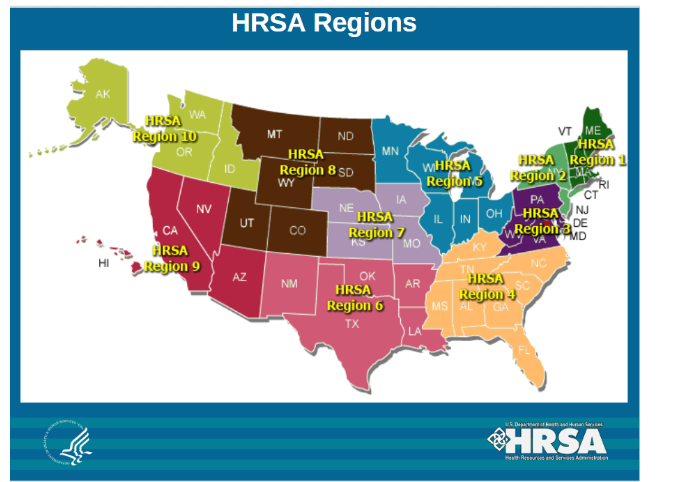
HRSA Regions
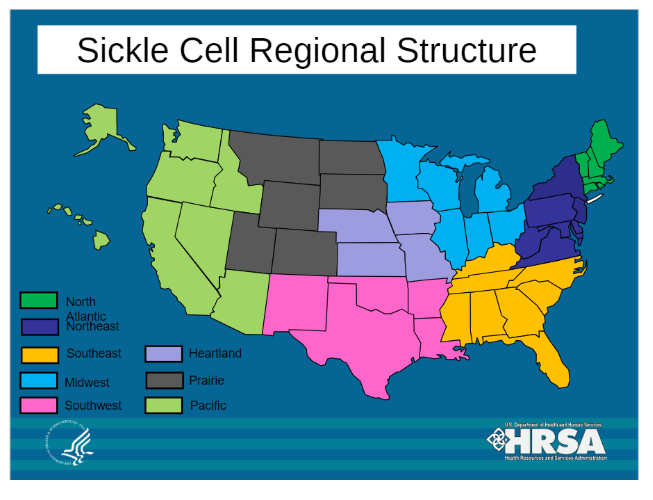
Sickle Cell Regional Structure
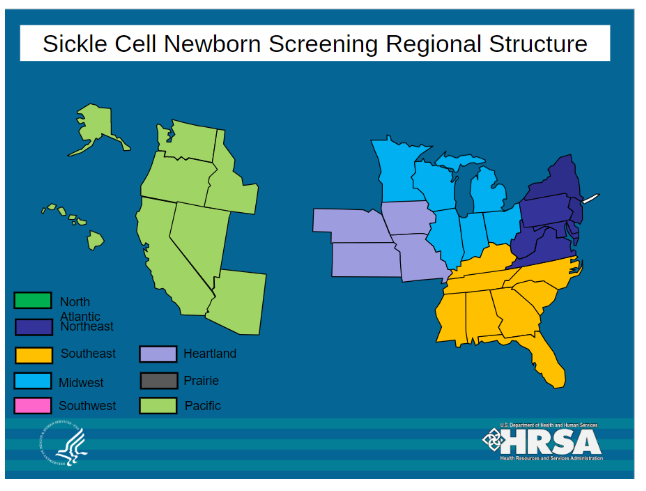
Sickle Cell Newborn Screening Regional Structure
1. Individuals living with sickle cell disease culturally refer to themselves as “Warriors” or “Sickle Cell Warriors”. | Coined in early 2000’s by nurse activist Tosin Ola in her original blog ‘Sickle Cell Can Kiss My @ss!
The National Heart, Lung, and Blood Institute (NHLBI) published Evidence-Based Management guidelines in 2014 that focused on supporting primary care physicians to address challenges with access to quality. Dissemination and implementation of these guidelines remain suboptimal.
The Education and Mentoring to BRing Access to CarE (EMBRACE) Network is a regional collaborative of 8 southeastern states (AL, FL, GA, KY, MS, NC, SC, TN) committed to collectively engage with the SCD community and various stakeholders to:
- Increase the number of providers adhering to NHLBI guidelines to provide care for persons with SCD
- Increase the pool of providers offering evidence based SCD care by disseminating technology based provider support tools (tele-mentoring and telemedicine)
- Develop and implement strategies to improve access to quality care in a SCD medical home with a focus on individual and family engagement.
Education and Mentoring to BRing Access to CarE for SCD (EMBRACE)
Ifeyinwa (Ify) Osunkwo, MD, MPH
Ify.Osunkwo@carolinashealthcare.org
HRSA-17-078
Through regular ECHO® clinics, like virtual grand rounds, patient case presentations will be combined with didactic learning and mentoring. These sessions are open to health care providers who want to engage with a team of multi-disciplinary specialists around the management of sickle cell disease.
Benefits of ECHO®
-
- Specialists in sickle cell disease train community providers in an area outside of their expertise.
- Specialists use low-cost videoconferencing to conduct tele-ECHO clinics
- Expands access to care for rural and underserved patients
- Rapid dissemination of best practices
- Providers receive CME/CE and MOC III/IV points for participating.
Just as implementation of the NHLBI guidelines vary greatly among healthcare institutions, the uptake of guideline-recommended interventions remains low among sickle cell patient warriors*.
EMBRACE tackles this issue through Education, Engagement, and Empowerment.
|^ See EMBRACE Education, EMBRACE Engagement, EMBRACE Empowerment ^|
Principal Investigator(s): Osunkwo, Kanter, Strouse
Transition specialist(s): Coretta Jenerette
Community Engagement Partner(s): Sickle Cell Consortium
Healthcare Institution(s): Atrium Health
HRSA Regions
Sickle Cell Regional Structure
Sickle Cell Newborn Screening Regional Structure
1. Individuals living with sickle cell disease culturally refer to themselves as “Warriors” or “Sickle Cell Warriors”. | Coined in early 2000’s by nurse activist Tosin Ola in her original blog ‘Sickle Cell Can Kiss My @ss!